Thirty minutes. No pitch. Just a map of what your marketing is missing. Send your brief →

Workflow Automation. Connect your stack. End the manual work in between.
We build the workflows that move data between the tools you already use n8n, Zapier, Make, HubSpot, Salesforce, Slack then we monitor them every day and maintain them every month so they don’t quietly break. One week to audit your stack. One flat monthly retainer from £1,497. No per-task surprises, no abandoned builds, no silent failures.
Monthly retainer starting at £1,497. You don’t maintain the automations. We do.


4.9 from 2500+ reviews
Your customer data lives in seven places. Reps copy it between three of them. Then somebody types it into a fourth.
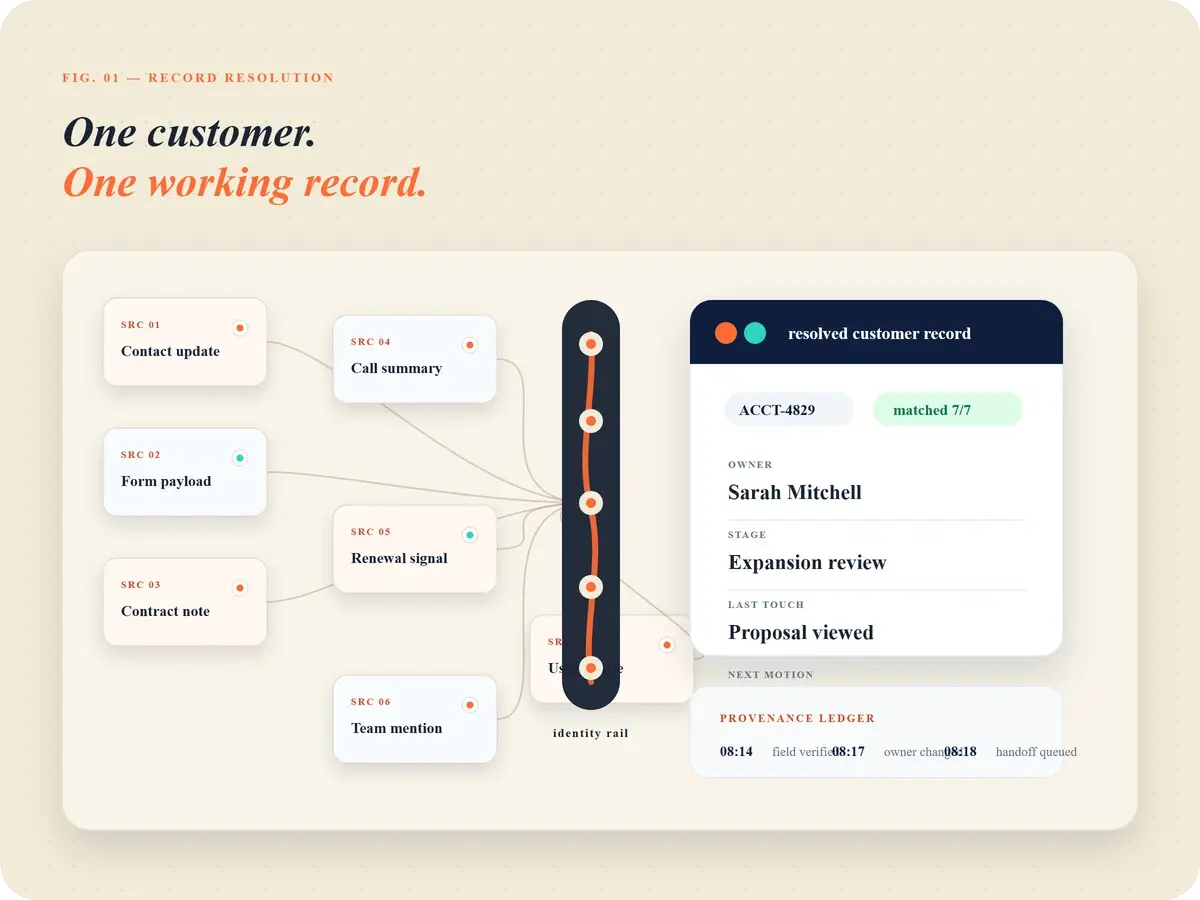
Connect the stack. Eliminate the silos.
The day-to-day of a modern revenue team is a sequence of small data transfers your team is doing by hand. A new lead lands in HubSpot. Someone copies the email into a Mailchimp segment. The deal moves stages in Salesforce. Someone pastes the company name into a Slack channel. The customer signs the contract. Someone updates Notion, then Airtable, then the finance spreadsheet.
Every one of those copy-paste steps is a workflow that should have been built on day one and never was. We map every manual handoff in your stack during the discovery week, name a source of truth for each customer data field, and build the workflows that move the data without involving a person.
The build runs on n8n, Make, or Zapier. The choice is made on technical fit task volume, self-hosting needs, complexity ceiling not on which platform we prefer.
CRM, email, Slack sync in both directions.
“Two-way sync” sounds simple until your HubSpot deal stage and your Salesforce opportunity stage disagree on a Friday afternoon and your VP of Sales wants to know which one is real.
Bi-directional sync, done correctly, is a set of explicit decisions: which system owns which field, what happens when both systems update the same record in the same hour, how duplicates are detected and merged, and how lookup-field relationships are preserved across the sync boundary. We make those decisions with you during the Unified Stack Protocol™ week, write them down, and then build the workflows that enforce them.
We do this for HubSpot ↔ Salesforce, HubSpot ↔ Pipedrive, Salesforce ↔ Marketing Cloud, and any combination where two CRMs or a CRM and a marketing tool are both trying to be the system of record for the same customer.
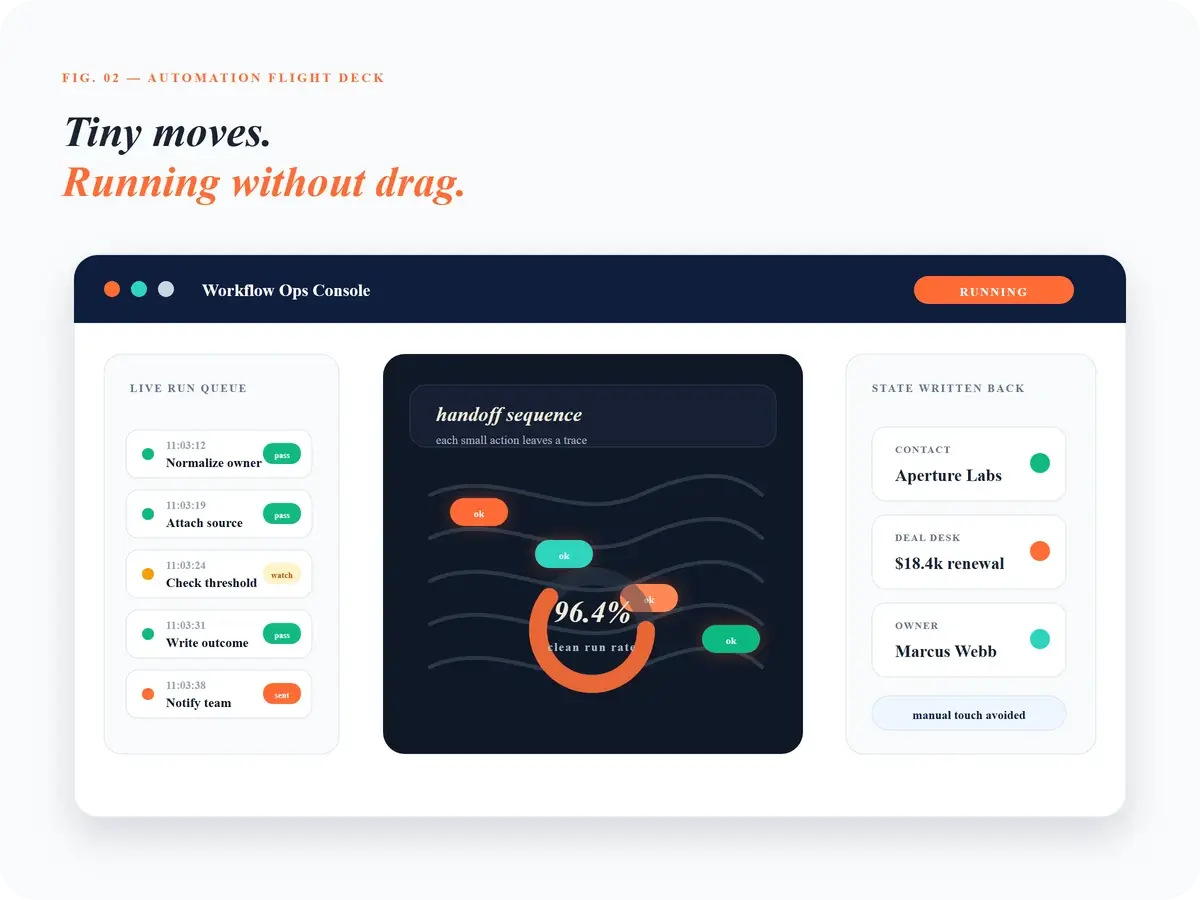
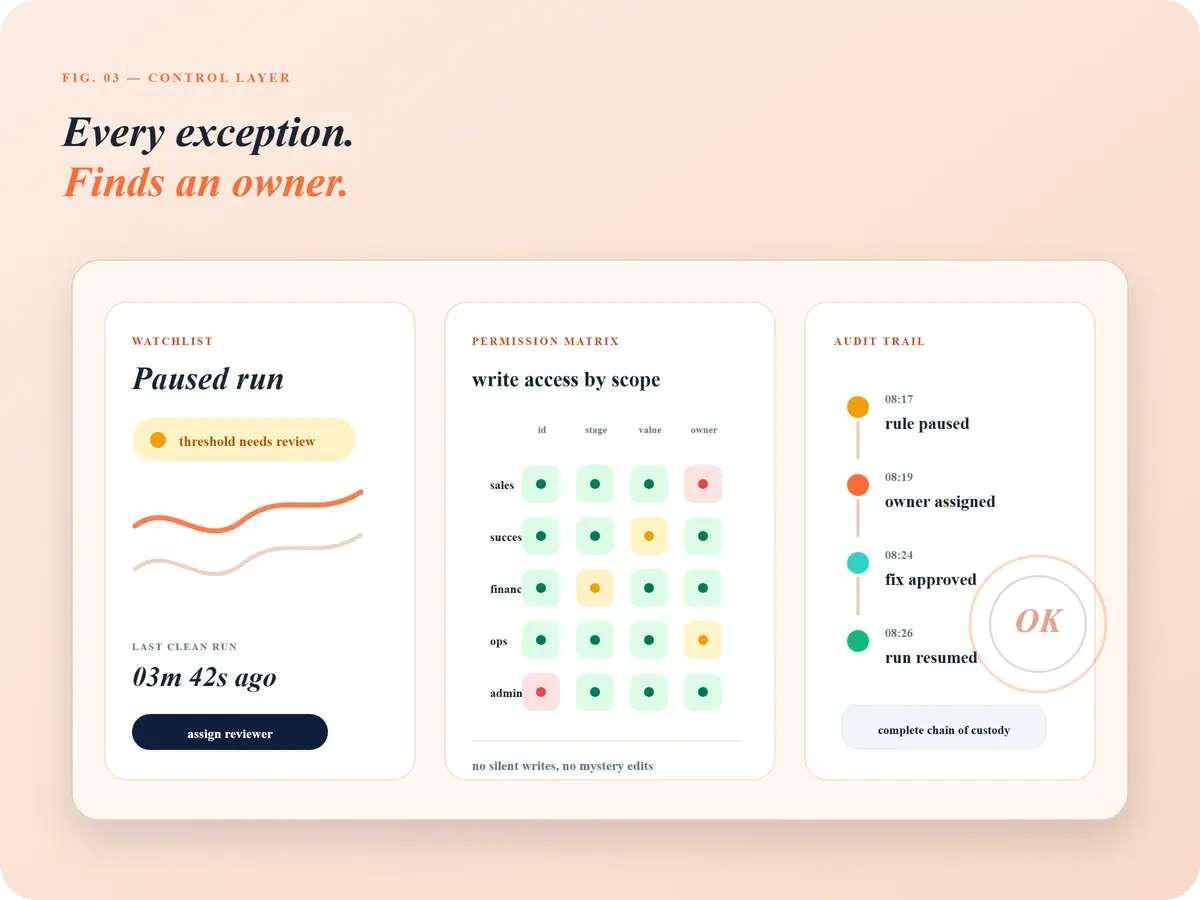
Most broken automations stay broken because nobody notices. We notice.
The standard automation failure mode is silent. A token expires. A field name changes upstream. A rate limit gets hit. The workflow stops firing. Three days later your sales team mentions that lead alerts have gone quiet. By the time you trace it back, you’ve lost a week of pipeline.
Every workflow we build runs through the Zero-Breakage Pipeline Architecture™. Every flow has an error trigger branch. When a step fails, the failure event reaches your Slack channel inside 60 seconds. The engineer on our side triages, contains the failure, and either ships a fix or queues the impacted records for replay once the upstream service recovers. You find out about the failure before your customers do.
The monthly retainer covers the monitoring, the triage, the fixes, the version upgrades when n8n ships a new release, the schema migrations when HubSpot adds a property, and the documentation that keeps it all legible to whoever inherits the workflows next.
Five phases. Week one delivers the architecture. Phase five keeps it alive.
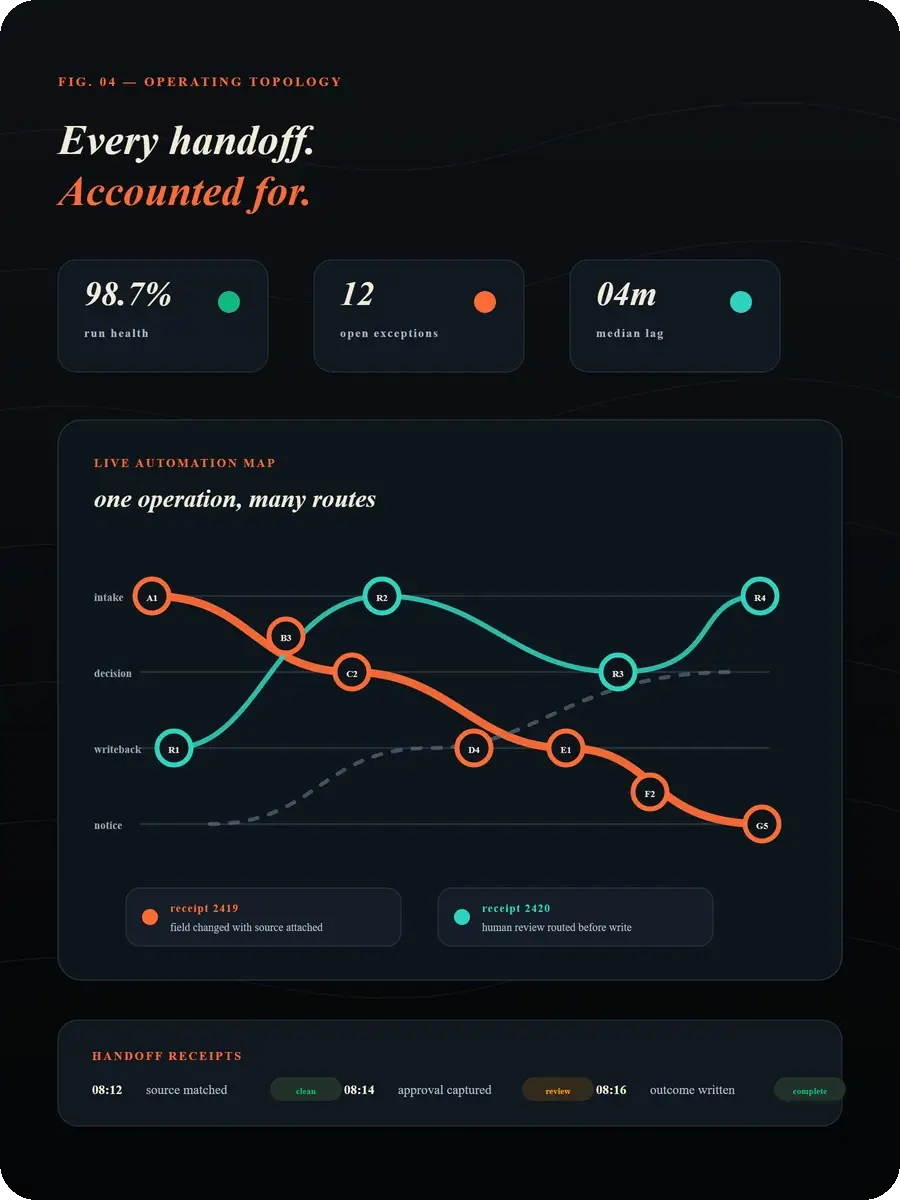
01 / The Unified Stack Protocol™ (Week 1)
One week. Not flexible.
The first week is discovery and auditing only. We map your stack with you every tool currently holding customer data, every place an employee is currently the data-passing layer between two systems, every workflow that already exists and probably shouldn’t. The week produces three named deliverables: the Stack Topology Map, the Manual-Handoff Inventory, and the Source-of-Truth Designation.
The first time your founder sees the Stack Topology Map is usually the first time they’ve seen their own data flow drawn correctly. That’s the reason this phase is structured the way it is.
02 / Architecture & Platform Selection
We choose the automation platform per use-case, not per dogma. Self-hosted n8n for high-task-volume operations where the per-task cost of Zapier would be prohibitive. Make for visually-complex scenarios with heavy branching. Zapier for fast-shipping low-complexity flows where the build-time savings outrun the platform fees. The architecture decision is documented and defended in writing before any workflow is built.
03 / Build & Zero-Breakage Implementation
Every workflow shipped during this phase is built against the five Zero-Breakage Pipeline Architecture™ rules: error trigger branch, idempotent webhook handlers, field-schema drift guards, rate-limit backoff logic, and audit trail on every write. The build is reviewed against the rules before it’s deployed, not after it fails.
04 / Cutover & Parallel-Run Validation
For migrations and replacements, the new workflow runs in parallel with the old one for three to seven days. Outputs are compared. Discrepancies are tracked. The old workflow is decommissioned only after the new one has produced identical results across the full reporting window.
05 / Monthly Maintenance & Monitoring
The retainer covers ongoing operation. Errors trigger Slack alerts inside 60 seconds. Schema changes in upstream tools are caught by the drift guards before they break downstream steps. Platform version upgrades are managed for you. Every month, you receive a maintenance report showing what fired, what failed, what was fixed, and what was added. The retainer is month-to-month after the initial Phase 01 sprint.
Three tiers. Flat monthly fee. You're never billed by the workflow, and you're never doing the work yourself.
Connect & Monitor
Up to 5 connected workflows. Built once. Monitored continuously.
£1,497
/ month
- One vetted automation engineer (~10 hrs/wk equivalent capacity)
- The Unified Stack Protocol™: full 1-week discovery sprint
- Up to 5 workflows built on n8n, Zapier, or Make
- Zero-Breakage Pipeline Architecture™ on every flow
- Slack error alerts (under 60 seconds)
- Monthly maintenance window
- Quarterly workflow review
For B2B teams with a defined automation scope 5 to 10 workflows that need to be built once and kept alive without becoming someone’s part-time job.
Build & Maintain
Up to 15 workflows. Full-stack sync across CRM, email, Slack, and PM tools.
£2,997
/ month
- Everything in Connect & Monitor, plus:
- Up to 15 workflows under continuous management
- Bi-directional CRM sync (HubSpot ↔ Salesforce, or equivalent)
- Automated lead routing build (territory + ICP + capacity logic)
- Continuous CRM hygiene workflow (dedup + field validation + stale-record archival)
- Custom JSON payload handling
- Slack notification design (per-workflow, branded)
- Bi-weekly architecture office hours
For B2B teams already running CRM, marketing automation, and sales engagement tools and feeling the gaps between them. Most common entry tier for £5M–£50M ARR companies.
Full Stack Automation
Unlimited workflows in scope. Dedicated engineer. Self-hosted infrastructure.
£4,997
/ month
- Everything in Build & Maintain, plus:
- Unlimited workflows within agreed-scope domain
- Dedicated automation engineer (named, not pooled)
- Self-hosted n8n deployment on your AWS, GCP, or Azure
- Custom n8n node and connector development
- Custom API integrations (REST and webhook-based)
- 24/7 Slack monitoring with on-call rotation
- Monthly architecture review with your RevOps lead
For revenue teams treating automation as a core operational discipline. Companies at this tier typically have a head of RevOps, a defined automation roadmap, and want the engineering capacity without hiring an in-house team.
Common questions about Workflow Automation
Where does our customer data live during a workflow automation engagement, and who has access to it?
Your customer data continues to live in your own systems — your CRM, your data warehouse, your help desk — not in any RankThread-owned database. The automation platform we build on (n8n, Make, or Zapier) acts as a transient router that moves payloads between your systems; it does not retain a persistent copy of your records.
For self-hosted n8n deployments, the automation infrastructure also runs inside your cloud account (AWS, GCP, or Azure), so no third party holds your data at rest. Our engineers receive scoped credentials through your password vault, time-boxed access, and we rotate credentials between engagements.
We do not use your data to train anything. Inference on any AI tooling we use runs through zero-retention enterprise endpoints (Anthropic Claude, OpenAI), which means your prompts and data are never stored, logged, or used to train future models.
What happens when a workflow fails in the middle of the night?
Every workflow we build runs through the Zero-Breakage Pipeline Architecture, which includes an error trigger branch on every flow. When a step fails — a token expires, an API rate limit hits, a schema drifts upstream, a downstream service goes down — the failure event reaches your Slack channel inside 60 seconds.
The on-call engineer on our side triages, contains the failure, and either ships a fix or queues the impacted records for replay once the upstream service recovers. You find out about the failure before your customers do, not three days later when your sales team mentions that lead alerts have gone quiet.
Monitoring is continuous, not best-efforted. It is the reason this is a monthly retainer and not a one-off build.
If we work with you on n8n and then decide to leave, are we locked in?
No. Every workflow we build is documented in a stack-agnostic specification — trigger conditions, business logic, field mappings, error handling rules. If you later choose to migrate to a different platform or build the work in-house, the documentation transfers.
The workflows themselves are also exportable. n8n JSON exports, Make scenario blueprints, and Zapier zap exports are yours to keep on day one. We hand them over at the end of the Unified Stack Protocol week, not at the end of the engagement.
The retainer is on the ongoing work, not on the lock-in.
Can you migrate our existing Zapier workflows to n8n to cut the per-task bill?
Yes. The migration follows a four-stage process: full Zap inventory and execution-frequency audit, n8n architecture design, parallel-run validation period of three to seven days, and supervised cutover.
Self-hosted n8n typically reduces effective automation cost by 60 to 90 percent for teams running more than 10,000 tasks per month. Actual savings depend on your specific workload, your hosting setup, and whether you want managed n8n cloud or self-hosted infrastructure. We model both before recommending one.
Most clients break even on the migration cost inside the first quarter and save the rest as MRR drag eliminated from their stack budget.
How do you handle bi-directional sync between HubSpot and Salesforce without duplicates or conflicting updates?
Bi-directional sync is governed by an explicit Source-of-Truth Designation built during the Unified Stack Protocol discovery week. For each customer data field, one of the two systems is named the system of record, and conflict resolution rules cascade from that designation.
Deduplication is handled with deterministic matching on a primary key plus phonetic and probabilistic matching on supporting fields. Lookup-field relationships are preserved across the sync boundary using association sync rules, not best-guess pairing.
Where both systems update the same record inside the same sync window, the SOT designation governs which value wins, and the losing value is logged to the audit trail. Nothing is silently overwritten.
Stop running the work that should be running itself
Twenty minutes. No deck. Just a live look at where data is leaking out of your stack, which copy-paste handoffs are quietly eating your week, and where the next workflow should plug in. You walk away with the Stack Topology Map in week one. Before any contract gets signed.
Book the audit