Thirty minutes. No pitch. Just a map of what your marketing is missing. Send your brief →

An mvp development  company for b2b founders who need the product to ship on budget and on plan.
Scoped b2b app development from architecture to ship. Every engagement starts with a documented Zero-Debt Architecture Plan™ every feature, API, and tradeoff on paper before a line of production code, and ends with a 30-day Launch & Handoff Protocol™ that transfers every account, every runbook, and every Architecture Decision Record to your team. One-time project pricing starting at £4,997.


4.9 from 2500+ reviews
A b2b app development engagement built on scoped architecture, a documented MVP, and a 30-day launch protocol, so the product ships on a plan instead of a moving target, and the codebase is yours to keep from day one.
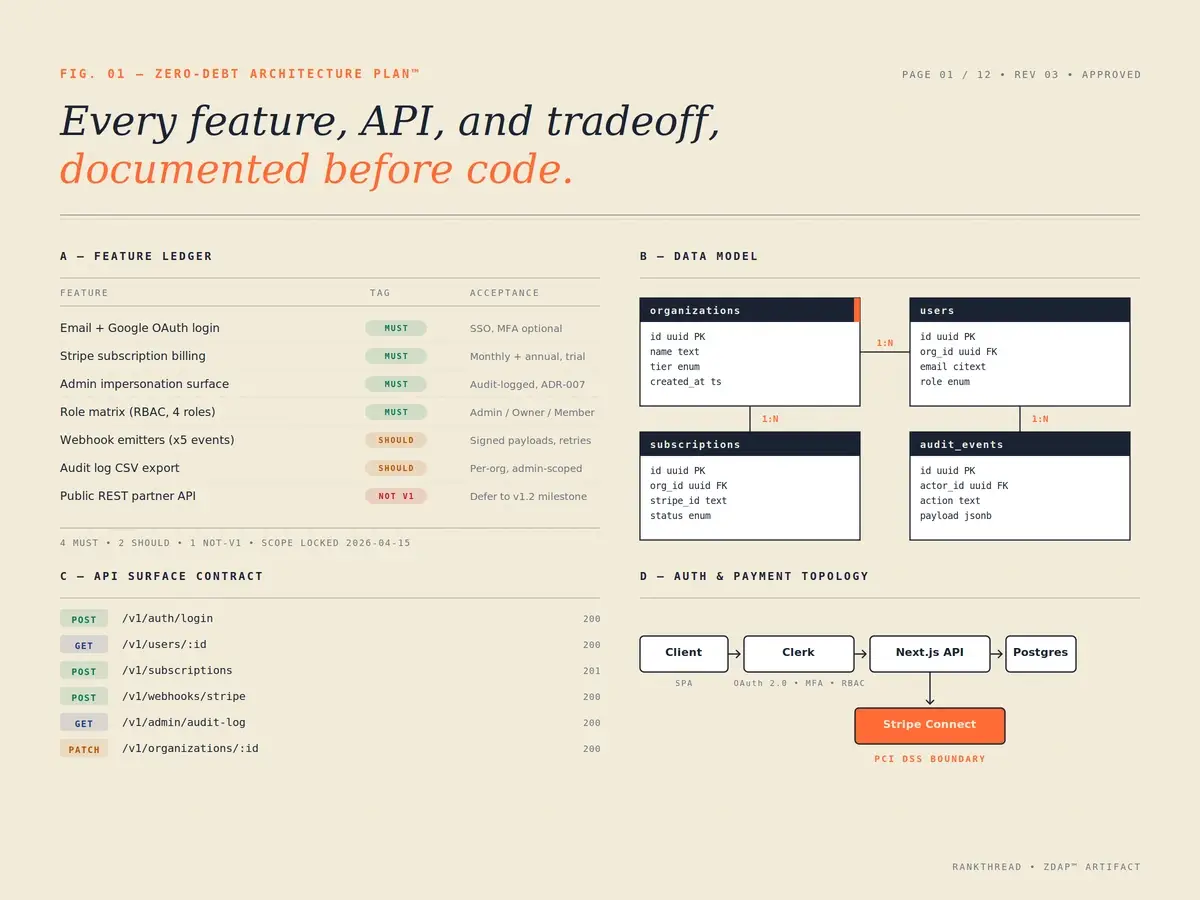
Zero-Debt Architecture Plan™ every feature, API, and tradeoff documented before the first line of code.
The most common frustration we hear from founders who have been through a b2b app development project before: “We signed a contract for £40K, and by month three the invoices were at £75K with no clear explanation of where the extra money went.
” MVPs built without a locked architecture artifact average a 27 percent budget overrun by the time they launch, sometimes more. Every RankThread engagement, from a standalone architecture plan to a full saas mvp development build, starts with the same deliverable: a Zero-Debt Architecture Plan™.
It documents the scoped feature ledger (every feature tagged Must-Have, Should-Have, or Not-In-V1 with acceptance criteria written against each Must-Have), the data model and schema, the API surface contract, the auth and payment topology, the non-functional requirements, and an explicit tech-debt budget. The Plan is approved before a line of production code is written, because scope creep is prevented at the artifact, not at the invoice. For projects that turn out to be closer to a marketing site than a software product, we route to custom web design instead of continuing down the mvp development agency track.
Production builds with auth, payments, admin dashboards, and scalable API architecture.
Our default production stack is TypeScript on Next.js and Node.js with a PostgreSQL data model, deployed on Vercel or AWS with CI/CD through GitHub Actions, a stack chosen for long-term hireability, typed integrity at the database boundary, and low operating cost at MVP scale.
Auth runs through Auth0 or Clerk with OAuth 2.0, MFA, and role-based access control defined at the role-matrix level. Payments run on Stripe or Stripe Connect depending on whether the product needs marketplace or multi-party billing. The admin dashboard is a first-class surface, built into the Plan from day one, not retrofitted at the end, because internal tooling reliably becomes 30 percent of an MVP’s codebase once real users hit production. And for custom saas development in regulated verticals, SOC 2, HIPAA, and PCI DSS posture is architected from Phase 01, not bolted on at audit time.
Same model applies whether the build is enterprise web app development, enterprise mobile app development, or both.
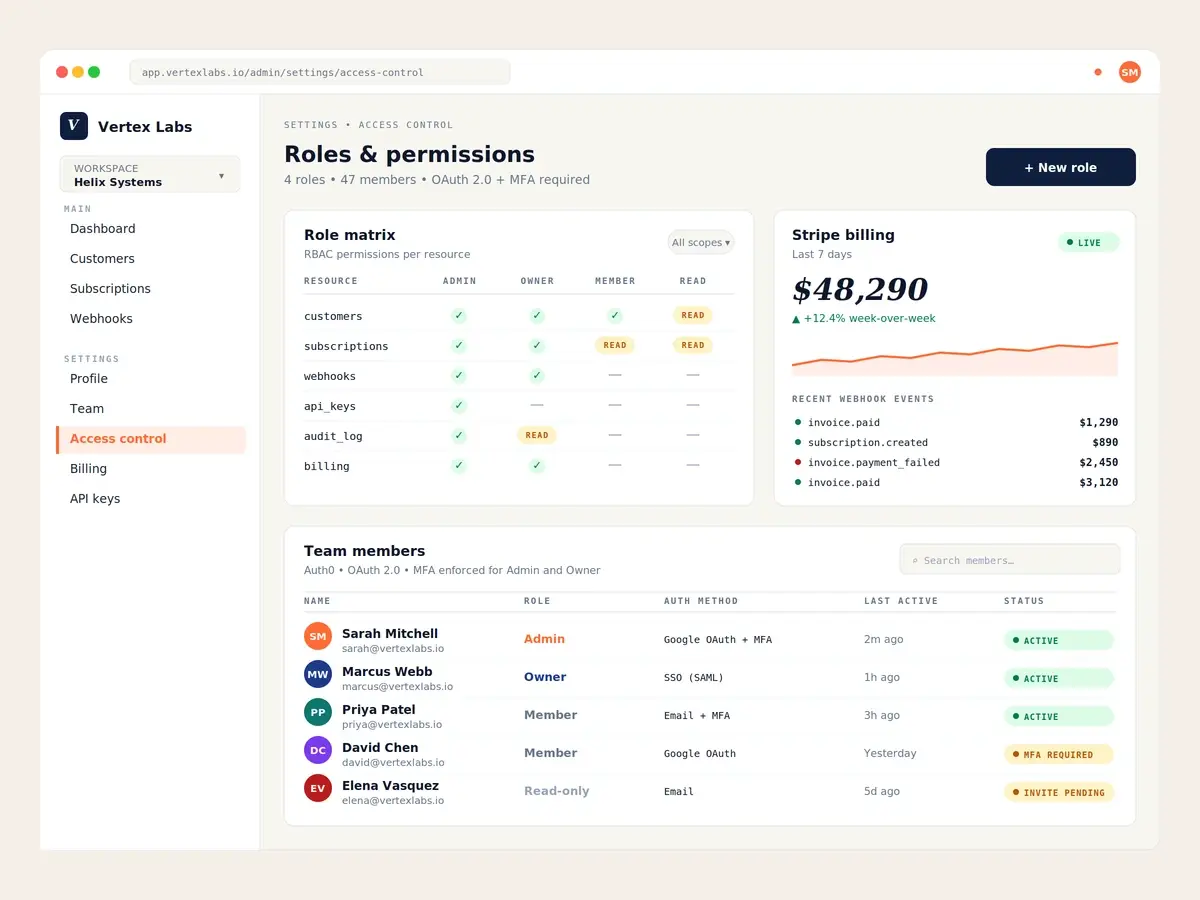
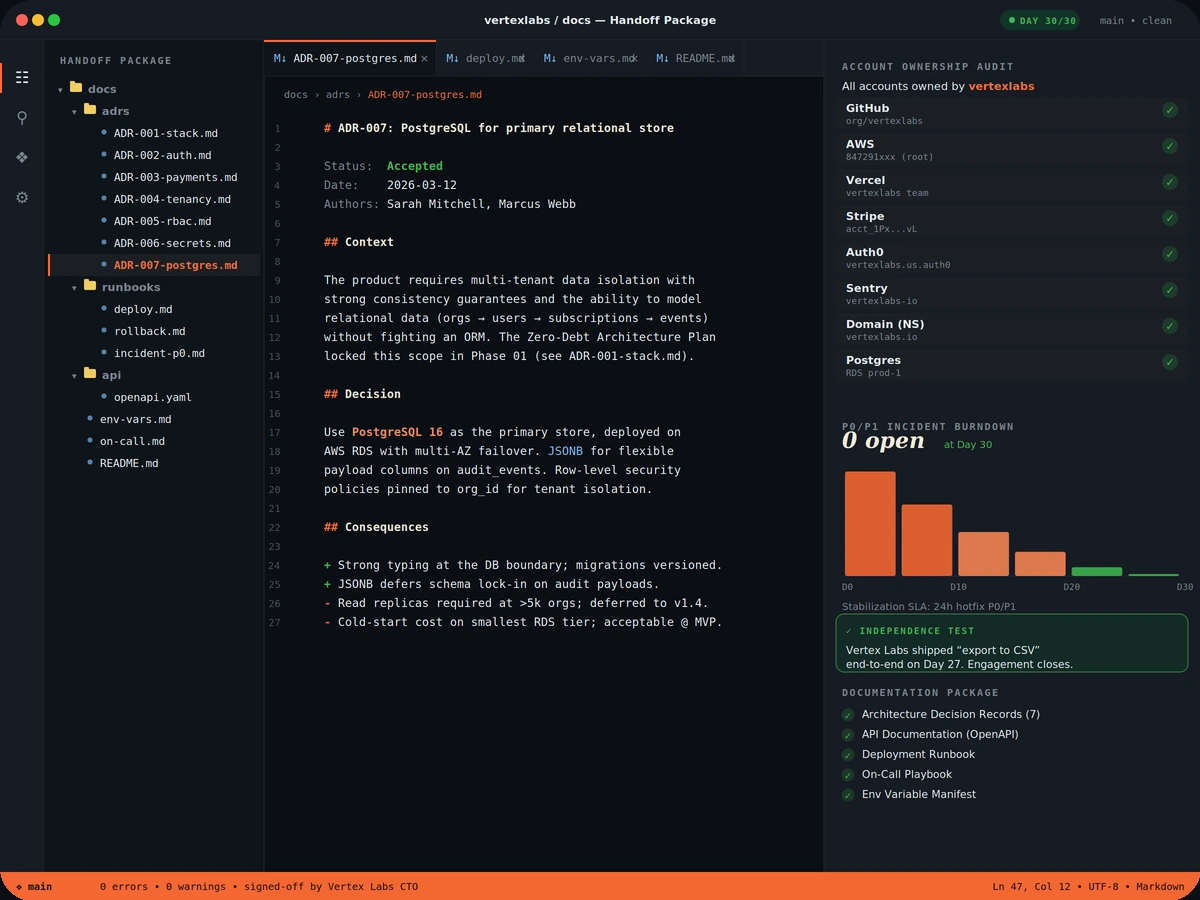
Launch & Handoff Protocol™ 30 days of stabilization, runbooks, and a codebase you actually own.
Too many engagements end the same way: the agency ships, support calls fade out, and the first production bug shows up to a team with no runbook, no on-call rotation, and no documentation to hand the next engineer. Our Launch & Handoff Protocol™ is the built-in counter.
Day 0 is an account ownership audit, GitHub, AWS or Vercel, Stripe, Auth0, domain registrar, Sentry, everything, confirmed as created under your organization, with us as collaborators inside your accounts, never owners. Days 1–7 run a production stabilization window with 24-hour P0/P1 hotfix SLA. Days 7–14 deliver deployment, rollback, and incident runbooks.
Days 14–21 run architecture and operations knowledge-transfer sessions, recorded and delivered to your Drive. Days 21–30 run an independence test: your team ships one small feature end-to-end while we shadow. At Day 30 you receive the documentation package and can fire us and keep shipping, which is the point of how the Protocol is built.
Once live traffic starts, multi-touch attribution and revenue dashboards tie product usage to business outcomes, because shipping is the midpoint of a product build, not the finish line.
A 5-phase b2b app development process, built around one rule: at Day 30, you can fire us and keep shipping.
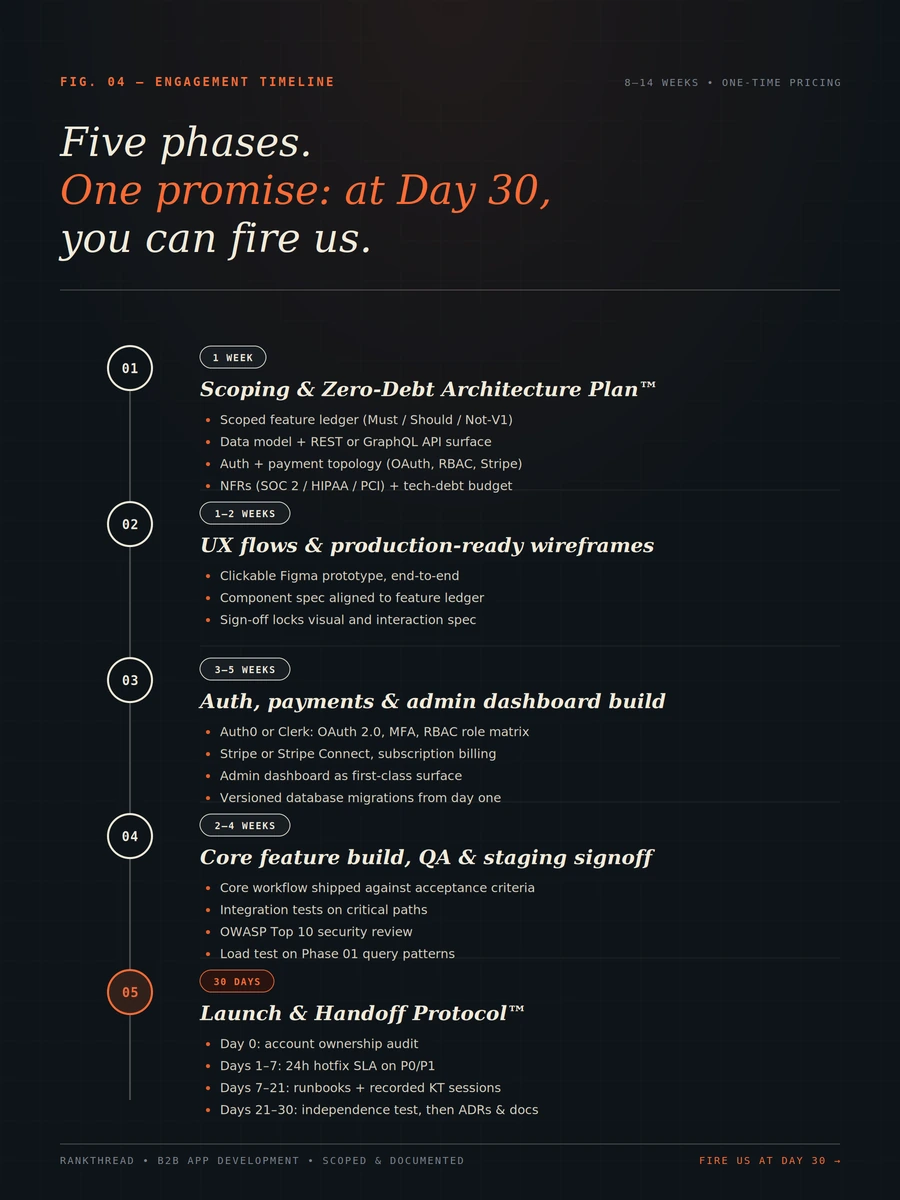
01 / Scoping and Zero-Debt Architecture Plan™
One week. Before any production code is written, we produce the Zero-Debt Architecture Plan™: a documented deliverable that plots the scoped feature ledger (every feature tagged Must-Have, Should-Have, or Not-In-V1 with acceptance criteria), the data model and schema, the REST or GraphQL API surface contract, the auth and payment topology (OAuth 2.0, RBAC, Stripe or Stripe Connect), non-functional requirements including SOC 2, HIPAA, or PCI DSS posture where applicable, deployment topology across staging and production, and an explicit tech-debt budget.
Wireframes and UX flows are drafted for approval in this same phase. For enterprise app development engagements, compliance scope is defined here, not after the first audit finding.
02 / UX flows and production-ready wireframes
One to two weeks. We produce production-ready wireframes in Figma with clickable prototypes and a full component spec, walking the scoped workflows end-to-end, from first login through primary task completion through account settings and admin views.
Every flow is reviewed against the feature ledger from Phase 01, so design and scope never drift apart. Your sign-off on the prototype locks the visual and interaction spec before any engineering begins.
03 / Auth, payments, and admin dashboard build
Three to five weeks. The first production build phase covers the three things every B2B SaaS actually needs before anything else matters: authentication (Auth0 or Clerk, OAuth 2.0, MFA, role-based access control tied to a defined role matrix), payments (Stripe, Stripe Connect for marketplace models, subscription billing where applicable, PCI DSS boundary documented), and the admin dashboard, a first-class surface built into the saas platform development plan, not a retrofit.
Database migrations are versioned from day one. Test coverage is written against critical paths, not chased after the fact.
04 / Core feature build, QA, and staging signoff
Two to four weeks. Phase 04 delivers the core workflow, the one domain-specific thing your product is actually for, plus integration tests, an exercised staging environment, a security review against the OWASP Top 10, and a load test on the expected query patterns documented in Phase 01. Every saas product development milestone ships to staging and is signed off against acceptance criteria from the Plan before it moves to production. No “trust us, it works in dev” handoffs.
05 / Launch & Handoff Protocol™ (30 days post-launch)
Thirty days of structured post-launch support. Day 0 is the account ownership audit. Days 1–7 are production stabilization with 24-hour P0/P1 hotfix SLA. Days 7–14 deliver deployment, rollback, and incident runbooks. Days 14–21 run recorded architecture and operations knowledge-transfer sessions. Days 21–30 run the independence test: your team ships one feature end-to-end while we shadow.
At Day 30 you receive the documentation package, Architecture Decision Records, API documentation, deployment runbook, on-call playbook, environment-variable manifest, and the engagement formally ends. For engagements in regulated verticals or with extended scope, this phase extends to 60 days.
B2b app development packages with milestone-based, one-time pricing, and exactly what's included.
Scoping & Architecture Plan
Zero-Debt Architecture Plan™ delivered. No production code.
£4,997
/ one-time
- Scoped feature ledger with Must-Have / Should-Have / Not-In-V1 tags and written acceptance criteria
- Data model, schema, and REST or GraphQL API surface contract
- Wireframes and UX flows in Figma (clickable prototype)
- Auth and payment architecture (OAuth 2.0, RBAC, Stripe topology)
- Non-functional requirements (SOC 2, HIPAA, or PCI DSS posture where applicable)
- Explicit tech-debt budget and deployment topology
For B2B founders, internal engineering leads, and technical diligence rounds, a CTO-grade architecture artifact delivered in one week. Use it to internally de-risk, hand to an existing team, or as Phase 01 of a full custom saas development services engagement.
Growth MVP Build
The scoped, shipped, documented B2B SaaS MVP.
£9,997
/ one-time
- Everything in Scoping, plus:
- Full MVP production build (auth, payments, admin dashboard, core workflow)
- React / Next.js / Node.js / TypeScript / PostgreSQL stack
- One third-party integration (Stripe, CRM, analytics, or equivalent)
- 30-day Launch & Handoff Protocol™
- Milestone-based billing (33/33/34) with scope locked to the Plan
- Complete documentation package at Day 30 (ADRs, API docs, runbooks)
Single-core builds start at £9,997, while full-scope MVPs typically range from £25,000 to £60,000. Our Zero-Debt Architecture Plan™ defines the exact cost before production begins. This is the standard model for our SaaS and B2B development engagements.
Enterprise Platform Build
Multi-tenant, compliance-ready, enterprise-scale.
£59,997
/ one-time
- Everything in MVP Build, plus:
- Expanded architecture scope (multi-tenant, regional data residency where required)
- SOC 2 readiness posture and HIPAA BAA boundary where applicable
- Stripe Connect, subscription billing, or complex payment topology
- SSO and SAML with multi-role RBAC
- Extended 60-day Launch & Handoff Protocol™
- Dedicated architect retained through launch
- Expanded documentation package with runbooks for compliance audit surfaces
For funded B2B SaaS scaling into regulated industries, enterprise app development, enterprise mobile app development, and multi-tenant platform products. Typical engagement 14–20 weeks. When the product is live, search engine optimization and pipeline-attribution content become the next investments.
Common questions about our b2b
app development services
How much does it cost to build a B2B SaaS MVP?
A B2B SaaS MVP typically costs between £25,000 and £150,000 end-to-end, with most scoped single-persona MVPs landing in the £40,000 to £80,000 range for a product with auth, a core workflow, an admin dashboard, and one payment integration. The first investment is usually the scoping and architecture artifact — a documented data model, API surface, and auth and payment topology — which runs £4,997 on its own and prevents the single biggest cost variable in app development: scope creep. MVPs built without an upfront architecture plan average a 27 percent budget overrun by the time they launch, so the Zero-Debt Architecture Plan™ typically pays for itself before a line of production code is written. A saas development agency charging fixed-price MVP contracts without a locked architecture artifact is almost always pricing against a moving target.
How do you prevent scope creep on a fixed-price app development project?
Scope creep is prevented by documenting the scope before any code is written and treating every post-Plan change as a formal change request with an attached cost and timeline impact — not a conversation in Slack. Every RankThread engagement starts with a Zero-Debt Architecture Plan™ that locks scope, data model, API surface, auth and payment topology, and non-functional requirements like SOC 2 or HIPAA posture. Inside the Plan, every feature is tagged Must-Have, Should-Have, or Not-In-V1, with acceptance criteria written against each Must-Have. When a new feature idea surfaces mid-build, it is logged against the Plan as a change request with scope impact and cost impact, then approved or deferred before it becomes code — which is how a scoped MVP ships on budget instead of landing at the industry-average 27 percent overrun.
Who owns the code, accounts, and infrastructure when the engagement ends?
You own everything from day one — not just the code, but every third-party account the product depends on. GitHub, AWS or Vercel, Stripe, Auth0 or Clerk, domain registrar, Sentry, and every other account is created under your organization with you as admin; we work as collaborators inside your accounts, never owners. At the end of the 30-day Launch & Handoff Protocol™, you receive the full documentation package: Architecture Decision Records, API documentation, deployment runbook, on-call playbook, and an environment-variable manifest. If the engagement ends, nothing lives on our side that you cannot access, no codebase is locked behind our payment, and no clause retains licensing rights to your product. At Day 30 you can fire us and keep shipping — which is the point of how the Protocol is built.
How long does it take to build a B2B SaaS MVP?
A scoped B2B SaaS MVP typically takes 8 to 14 weeks from contract signature to production launch — one week of scoping and architecture, one to two weeks of UX flows and wireframes, three to five weeks of auth, payments, and admin dashboard build, two to four weeks of core feature build and QA, followed by the 30-day Launch & Handoff Protocol™ that runs in parallel with early user traffic. Anyone quoting a four-week end-to-end MVP is usually either skipping the architecture artifact (which is where scope creep is prevented) or shipping code so thin it will need to be rebuilt before your first paying cohort loads in. The 8-to-14-week range assumes a single buyer persona, one core workflow, one payment integration, and one third-party integration. Add compliance scope or multi-tenancy and the Enterprise Platform timeline of 14 to 20 weeks applies instead.
What tech stack do you build B2B SaaS products on?
Our default production stack for saas development company engagements is TypeScript on Next.js and Node.js with a PostgreSQL data model, deployed on Vercel or AWS with CI/CD through GitHub Actions — a stack chosen for long-term hireability, strong typing at the database boundary, and low ongoing operating cost at MVP scale. Auth runs through Auth0 or Clerk with OAuth 2.0, MFA, and role-based access control. Payments run on Stripe or Stripe Connect depending on whether the product has a marketplace or multi-party billing model. Error monitoring runs on Sentry, and the admin dashboard is a first-class built-in-house surface, not a retrofit. When the product warrants a different stack — a mobile-first build in React Native, a real-time surface on a different framework, or an AI pipeline — we document the tradeoff in the Zero-Debt Architecture Plan™ before the stack is locked in, so the choice is on the record.
Let's scope your build
Thirty minutes. No pitch. Just a clear picture of what your product actually needs, what the Zero-Debt Architecture Plan™ would look like on your feature list, and how soon we could have a production-shippable MVP in front of buyers.
Book a call